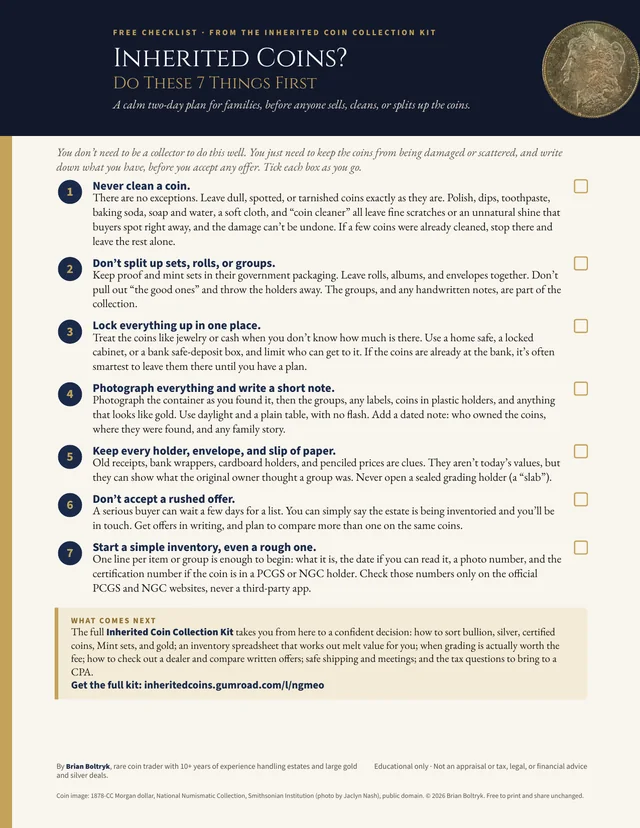
Inherited a coin collection? Here’s what to do first.
You’re not a collector, and someone may already want to buy it. Slow down. In a few calm steps you can protect the coins, find out what’s in the box, and get fair written offers.
Free PDF, delivered by Gumroad. Just enter your email to download.
The most expensive mistakes happen in the first few weeks
Someone polishes a coin “to see it better,” breaks up a proof set, or accepts the first cash offer because nobody knew what was in the box.
None of that is about being careless. It happens with good intentions, and almost all of it can be avoided. The first job isn’t to sell. It’s to keep everything as it is, write down what’s there, and give yourself time.
- Don’t clean anything, ever
- Keep sets, rolls, albums, and holders together
- Lock it up and photograph it as you found it
- Don’t accept a rushed offer
Not a hidden fortune, and not “just face value”
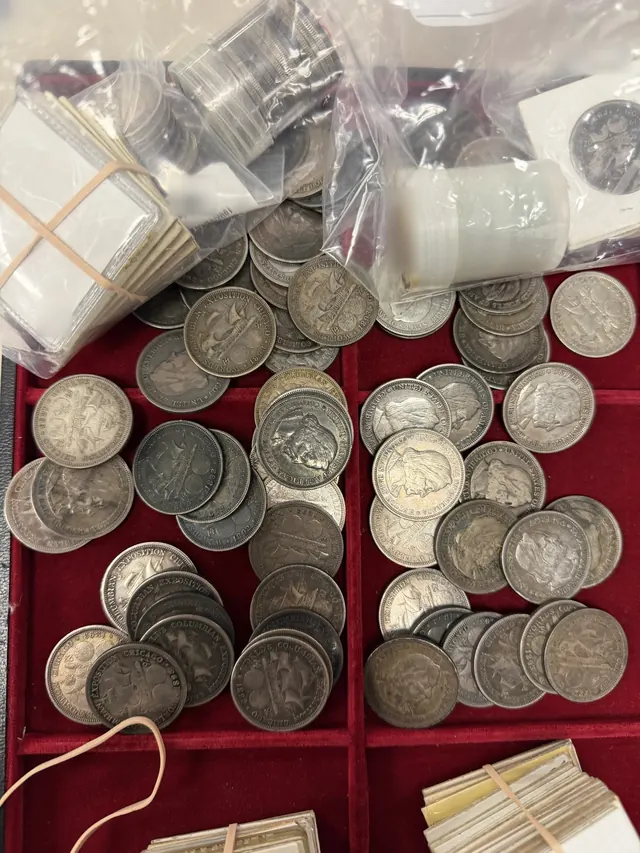
A typical inherited box is a mix. Here’s what to look for, and what to set aside.
| What you may find | What to know |
|---|---|
| Dimes, quarters, and half dollars dated 1964 and earlier | 90% silver. Often valued by their silver content, but list them before you sell them as a group. |
| Kennedy half dollars dated 1965–1970 | 40% silver. |
| Wartime nickels, 1942–1945, with a large mint mark above Monticello | 35% silver. Some 1942 nickels are ordinary nickel, so the mint mark matters. |
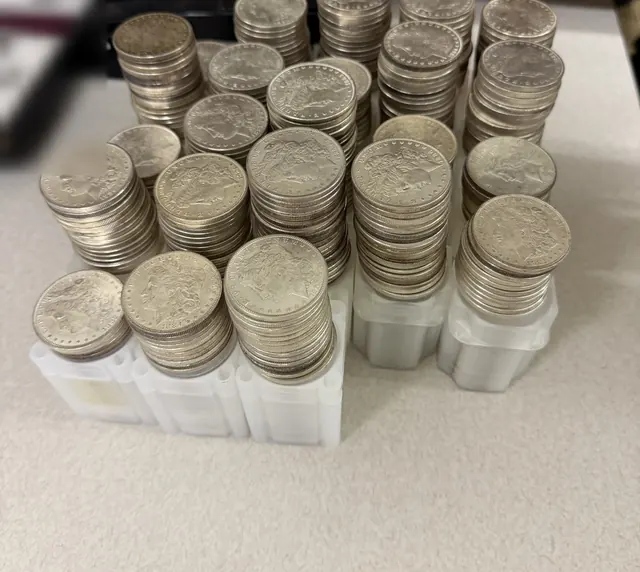
| Morgan dollars (1878–1904, 1921) and Peace dollars (1921–1928, 1934–1935) | 90% silver, about 0.77 oz each. Melt is the floor, and some dates are worth far more. Silver dollar guide |
| Proof sets and mint sets in government packaging | Keep them together. Many modern sets aren’t a windfall, but a complete set in its box is worth more than loose coins. |
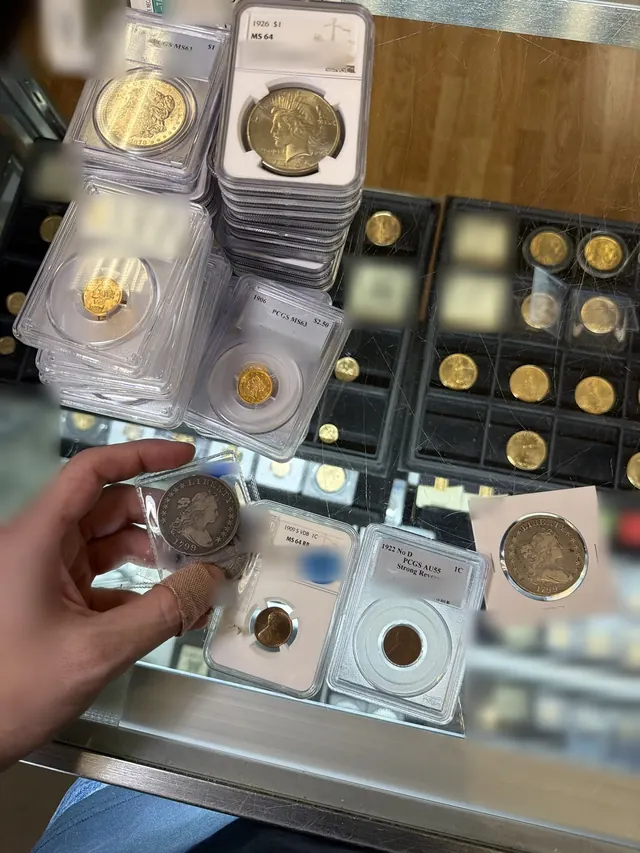
| Gold coins, certified “slabs,” or anything unusual | Set these aside for an in-person look. Never open a sealed holder. |
| Private-mint medals in fancy cases | Not the same as U.S. Mint coins, even with a certificate of authenticity. |
Metal content is general information for common issues. Coin values change daily and depend on date, mint mark, and condition.
Melt value and collector value aren’t the same thing
Melt value is the metal: the silver or gold in the coin times today’s price. It’s a floor, not a selling price. For example, a Morgan or Peace dollar holds 0.7734 troy ounces of silver.
Collector value is what someone will pay for the coin as a coin: the date, the mint mark, the condition, and whether a set is still complete.
For most worn, common coins, the two numbers sit close together. What you’re looking for are the exceptions, which is why you list the coins before anyone quotes a price for the whole lot.
How to find out what old coins are worth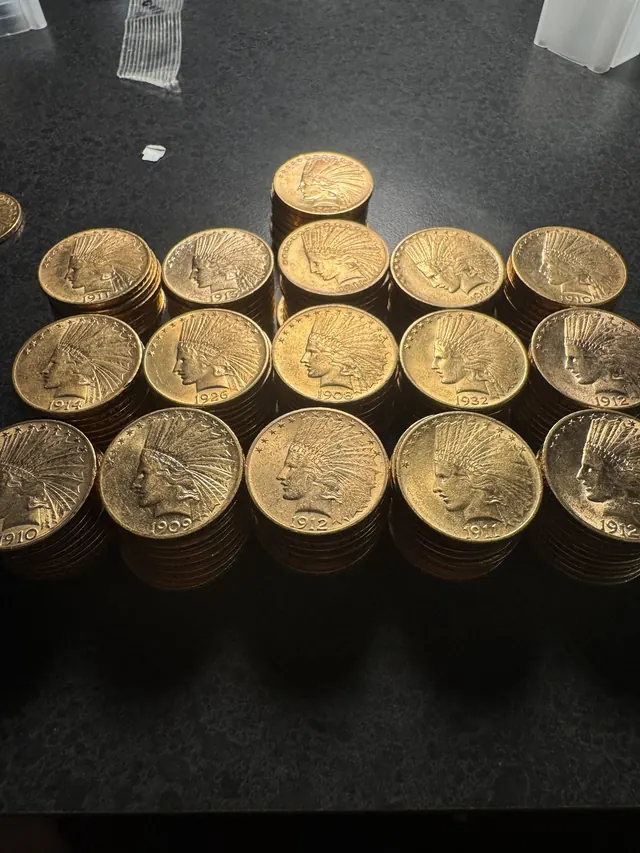
Start free, then get the full process
Each step builds on the last. Every paid guide includes a 30-day refund.
Step 1 · Free
Inherited Coins? 7 Things to Do First (Free)
One page for the first 48 hours. Print it and keep it on top of the box.
Only have silver dollars? The Inherited Silver Dollars Guide is $15 on its own.
Grading, dealers, and written offers
Most coins aren’t worth grading. They’re worth grading when they’re collectible for more than their metal and in good enough shape that the certified holder adds more than it costs. Worn common silver, bullion, or a jar of wheat cents almost never qualifies.
Check out the buyer. Start with how long they’ve been in business and whether they belong to the Professional Numismatists Guild (PNG). You can look up members yourself at pngdealers.org. Neither is a guarantee, but both are harder to fake than a friendly handshake.
Get two or three written, itemized offers on the same list. Tell buyers up front that you’re getting more than one.
Where to sell, comparedQuestions heirs ask
Should I clean the coins so they look better?
No. Cleaning leaves hairline scratches that buyers recognize, and grading services often give cleaned coins a “details” grade instead of a normal number. It can’t be undone. If a few were already cleaned, stop there and leave the rest alone.
Someone already offered to buy the whole box. What do I say?
You can simply say the estate is being inventoried and you’ll be in touch. A serious buyer can wait a few days for a list. When offers come, get them in writing and compare more than one on the same coins.
Is a jewelry store or pawn shop a good place to start?
Usually not as a first stop. Those counters are set up to buy metal, not to sort dates, mint marks, and original sets, so better coins can end up priced as scrap.
Do I owe tax just for inheriting coins?
In most cases, inherited property isn’t counted as income. Selling can create a taxable gain, usually measured from the value on the date of death. Read the plain-English taxes guide and talk to a CPA.
Which guide should I buy?
Start with the free checklist. If you have a mixed box, the Inherited Coin Collection Kit ($19) covers the whole process. If there are silver dollars too, the Heir’s Bundle ($29) adds the Silver Dollars guide and saves $5.
Not sure where to start? Start free.
The one-page checklist covers the first 48 hours: what never to do, how to keep everything safe, and how to start a simple list. Print it and keep it on top of the box.
Free PDF, delivered by Gumroad. Just enter your email to download.